
Walter Burton, his Customer, and the Victorian Snake Tattoo.

Walter Burton, Taxidermist and Entomologist , mounted two wild cats for his customer who sailed off to New York with a Victorian snake tattoo on his left arm.
In 1907 Edward Aubrey Courtauld Lowe, who commissioned two wild cats from Walter Burton F.Z.S. sailed off to New York to stay in a hotel and “get away from it all”.
The ship’s records describe him as having a distinctive mark of a snake on his left arm. I had always believed that tattoos were like cheap jewellery for the body, usually reserved for bawdy sailors or convicts. I was wrong!
Victorian Snake Tattoo
The idea of the Victorian snake tattoo intrigued me and so I read up a little bit on the subject of tattoos by reading Matt Lodder’s book “Tattoos. The Untold History of .a Modern Art” .
Tattoos are for the elite Victorian Society gentlemen
Edward Aubrey Courtauld Lowe society gentleman, was born in 1871, so it’s likely he was 18yrs to 20yrs old before he got the tattoo in about 1890. It’s only my conjecture, but it could have been either of two tattoo artists – Alfred South or Sutherland MacDonald – that Lowe visited, because the distance between them both was just 10 minutes’ walk – on Lowe’s London “patch” near The Strand.
Edward Aubrey Courtauld Lowe, society gentleman customer of Walter Burton, seems to have been the perfect candidate for a tattoo. In his book, Matt Lodder states that the elites set trends but that when they reached a wider audience, the elites dropped the trend and moved onto something else.

Sights of Victorian London

This silent film – free to watch – from the British Film Institute shows horse-drawn traffic on the Euston Road in 1900. This gives us a peek into the atmosphere and sights of the day. The Euston Road was the main artery for both Walter Burton and E.A.C. Lowe.
The snake tattoo is a Victorian trend
Actually, it turns out that my impression was wrong – that tattoos weren’t limited to the lower echelons after all, but that they were trendy amongst the upper classes of Europe who hid them under their clothing during their daily life, and by inference, exposed them in their private lives by night.
This would make perfect sense in the case of Walter Burton’s customer, the over-privileged society wild child without a purpose or direction.
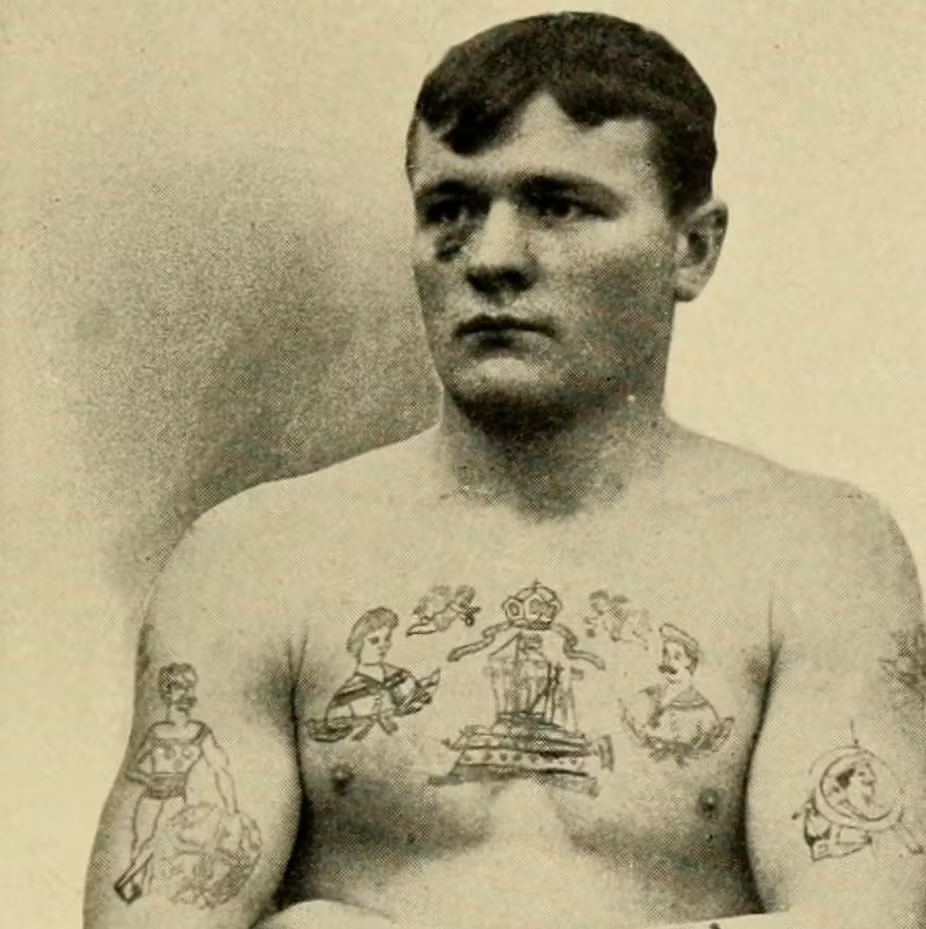
Tattooing had become a trend in Europe and the Americas during the 1800s, including amongst British Royalty. The described tattoo of the snake the left arm of Lowe sounds like it could have been one of the familiar patterns being offered by London tattooists to clients of the time.
Lodder shows an example illustration of the type of snake we might expect on his Instagram page.
Victorian Tattoo Artists – Sutherland MacDonald and Alfred South
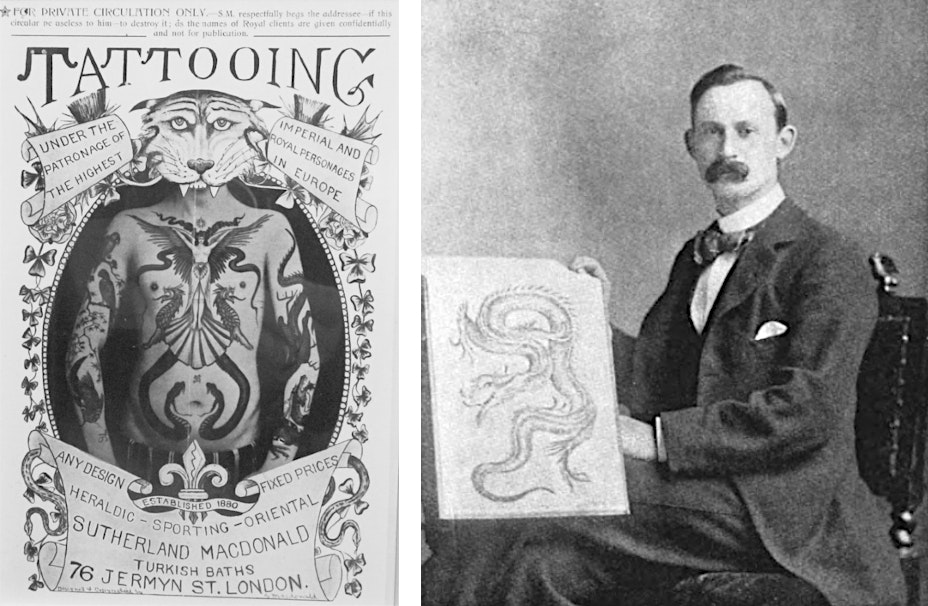
The most notable of the Tattoo Artists was Sutherland MacDonald, says Lodder, who set up in a lower level room in the Turkish Baths at 76 Jermyn Street from 1884 and who was the first professional tattoo artist working in London. So I did a bit of research and from old newspaper articles and directories I found that we see another artist named Alfred South working from The Strand from 1889.
This advertisement below is from the Sporting Times of 1899, and shows the two professional artists, MacDonald and South, advertising and competing with each other for business in London around the turn of the 19th century.


This article is part of the Victorian Taxidermists – Walter Burton hub. Back to Walter Burton →
Discover more from thevelvetdrawingroom.co.uk
Subscribe to get the latest posts sent to your email.


