
WALTER POTTER OF BRAMBER
The boy from an English Pub who put kittens in wedding clothes
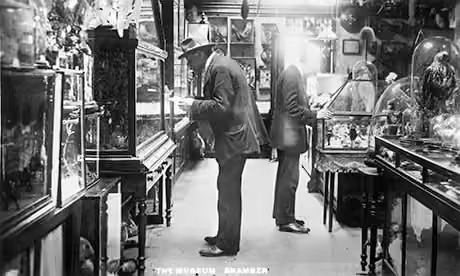

If you ask people to name a Victorian taxidermist still famous today, after Rowland Ward, you’ll most likely hear Walter Potter. He did not make hunting trophies. Delightfully, he dressed kittens for a wedding and seated rabbits at school desks. His small museum in a Sussex village became one of Britain’s best-known oddities, and people still talk about it more than a century after his death.
Walter Potter was born on 2 July 1835 in Bramber, a village in Sussex. His family ran the village pub, the White Lion, now called The Castle. He left school at fourteen. By about fifteen, he was experimenting with taxidermy, starting, so the story goes, with a pet canary.
A Pub, a Canary, And a Nursery Rhyme
His first big idea came from a children’s book. His sister is said to have shown him an illustrated nursery rhyme, and he set out to recreate its story in feathers. The rhyme was “The Death and Burial of Cock Robin”. The scene uses 98 species of British birds. One account says he began it at nineteen. The author, Pat Morris, says it took seven years to assemble, and it was shown in the pub’s summer house in 1861. Visitors loved it from the start.
FROM SUMMER HOUSE TO MUSEUM
The crowds of visitors grew. In 1866, Potter moved to larger premises, and in 1880 he moved again to a purpose-built building that still stands in Bramber. By then, it was known as “Mr Potter’s Museum of Curiosities”. Visitors arrived in throngs by train, and the platform at Bramber station had to be lengthened to cope with weekend crowds! Coach parties also came from Brighton, and the village soon became known for its tea gardens.
The Steyning Museum records that a supply of kittens came from a nearby farm in Henfield, and villagers also brought him specimens. One dealer lists a fox in an early box-style case signed “Walter Potter Bramber 1861”. If this is accurate, this could show that he was already working as a general taxidermist in the year that Cock Robin was first shown to the public. However, I interpret the pencilled date as “1867”, but that is up for debate.
Mostly scenes, some curiosities
The museum was famous for its tableaux, but it also held natural oddities, including two-headed lambs, four-legged chickens, and a Siamese pig. Visitors paid to see these, too. He finished his last great scene, The Kittens’ Wedding, around 1890. In the next article here, I will look at some of the best-known scenes.
WHERE DID HIS ANIMALS COME FROM?
STILLBORN, KILLED ON THE ROAD, OR KILLED DELIBERATELY?
Modern visitors always ask. Accounts say Potter used animals that were already dead: birds killed by cats or found on roads, stillborn rabbits, and rats and toads he prepared himself.
One review of the Morris and Ebenstein book on Potter also says they put surplus kittens from farm litters to death. I can quite believe this, because I have a lot of experience with cats and have always lived in the countryside; my family stories from previous generations recount the “culling” of kittens in buckets of water simply because no one could afford to sterilise their cats or feed numerous kittens. People considered it normal during the 19th and early 20th centuries.
People also raised the question in Potter’s own day, and later the museum was forced to put up notices saying the animals had died naturally and were over a hundred years old.
The family and the end
Potter married a local woman, Ann Stringer Muzzell, and they had three children. Sadly, he suffered a stroke in 1914 at the age of almost 80 and never fully recovered. He died on 21 May 1918 and was buried in Bramber churchyard. By then the museum held about 10,000 of his specimens. His daughter Minnie and his grandson continued to run it until the early 1970s. Walter Potter was not related to Beatrix Potter, although people often wrongly connect the two.
The Steyning Museum in the next village now holds only one thing he made: a stuffed canary. It was not his own pet, as the legend has it, but a neighbour’s, and it was never part of his display. The rest of his work went far from Sussex, as I will show later.

Walter Potter’s famous tableaux

Walter Potter and Hermann Ploucquet compared

Rare Walter Potter Tableau of Red Squirrels sells at auction £8,255

Taxidermy At The Great Exhibition 1851

What’s a Walter Potter Worth?

Hermann Ploucquet’s sensational tableaux at The Great Exhibition 1851
This article is part of The World of Victorian Taxidermy section. Explore more research here →
Discover more from thevelvetdrawingroom.co.uk
Subscribe to get the latest posts sent to your email.


