
Walter Potter and Hermann Ploucquet Compared
Making Animals Seem Human
Two men, born nineteen years apart and separated by the sea, made animals seem human, and both became famous for it. Hermann Ploucquet showed his scenes at the Great Exhibition in 1851. Walter Potter built his museum in a village in Sussex. Some people often mention them in the same breath, but they were very different.

Ploucquet’s “The Schoolmaster at Home”

Potter’s “The Rabbits’ Village School”
Hermann Ploucquet - The Trained Man
Hermann Ploucquet was born in Stuttgart in 1816. He taught himself taxidermy from a book as a child, then became an assistant at the royal natural history cabinet in Stuttgart at seventeen and, in 1847, its chief taxidermist.
In 1850 he won a medal at a trade fair in Leipzig. His job was to mount specimens for a scientific museum. He made his comic scenes with professional training

Ploucquet’s “Reynard Brings The Hare as a Witness”
Walter Potter - The self taught man
Walter Potter had no museum post and no scientific training.
He was the son of a publican, largely self-taught, and he learned by doing. One auction house describes his work as “lacking anatomical correctness” but “extraordinarily detailed”.
The artist Damien Hirst, an admirer of Potter’s famous tableaux, pointed out that, in one case, a kingfisher looked nothing like a Kingfisher.

The Scenes of Potter and Ploucquet
Ploucquet’s 1851 scenes at the Great Exhibition in London included dioramas of weasels hunting hares, duelling dormice, kittens drinking tea, ice-skating hedgehogs, shaving frogs, and a weasel schoolmaster disciplining rabbits.
His best-known work was a set of six scenes of Reynard the Fox. The composition and style of these displays were apparently greatly influenced by German artist Wilhelm von Kaulbach’s illustrations for Goethe’s classic poem, Reineke Fuchs (Reynard the Fox). Ploucquet’s comedy was sharp and satirical, whilst he also made serious scenes of birds of prey hunting, hounds baiting a boar, and a stag brought down.
Potter’s depictions were softer and more domestic – weddings, tea parties, village schools, cricket. The jokes are gentle and sentimental, and many are built on nursery rhymes.
Where Ploucquet laughs at human behaviour, Potter mostly dresses up animals as the people he knew.


Above: Some of Ploucquet’s scenes from the Great Exhibition 1851

Potter’s “The House That Jack Built”


Potter’s tableaux “The Happy Family”
Reactions and Reception
Ploucquet’s Great Exhibition work was lauded as a sensation. The Athenaeum called it the “most popular group of objects in the Glass Palace”, and Queen Victoria wrote in her diary that it was “really marvellous”. Albert Günther, who studied under him, called him “a perfect artist and the greatest taxidermist then living”. Not everyone approved: one critic in the Illustrated London News found the hunting scenes “disgustingly painful”.
Potter’s fame came much later and was of a different kind: first a village museum that visitors travelled to by train, then, after 2003, a name that appears in auction headlines. There was craft, of a kind, in Potter, which has never been rated highly, but the impact of his scenes speaks for itself.
Did Potter copy Ploucquet?
Some writers say Ploucquet’s work may have influenced Potter.
The Steyning Museum in Sussex says we cannot know whether Potter saw the 1851 scenes from the Great Exhibition; Potter was only sixteen at the time and did not officially start creating his first big tableau until he was nineteen.
The similarities between Potter’s and Ploucquet’s scenes, a rabbit school and a kittens’ tea party, are striking, and they are the kind of jokes Victorians reached for.
Nobody has yet proved a link.
What Survives?
Most of Ploucquet’s work has gone. After he lost his museum site to a railway in the 1860s, he sold much of his remaining work, and it reached the Crystal Palace at Sydenham in 1873 but was lost in the great fire of The Crystal Palace in 1936. His Reynard the Fox set survived: it stayed at Stoneleigh Abbey for decades, was sold by Christie’s in 1981, and is now in a private collection.
By contrast, much of Potter’s work survives, though it is scattered, and the linked article in this series traces some of it.


The Verdict
If you judge the quality of the animals, Ploucquet wins easily: he was a museum professional, and his mounts were the work of a master.
If you judge the pleasure, the story and the afterlife, Potter holds his own, and, of the two, he alone built a museum from his animated scenes.
A collector buying today is usually buying Potter’s story, not his taxidermy. The same isn’t true of Ploucquet’s scenes.
Or is it?

Walter Potter’s famous tableaux

What’s a Walter Potter Worth?
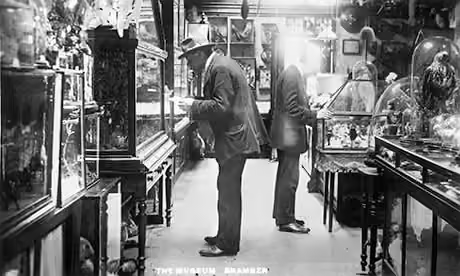
Walter Potter of Bramber
Hermann Ploucquet’s sensational tableaux at The Great Exhibition 1851

Taxidermy At The Great Exhibition 1851

Rare Walter Potter Tableau of Red Squirrels sells at auction £8,255
This article is part of The World of Victorian Taxidermy section. Explore more research here →
Subscribe to The Velvet Drawing Room
All content free to read | Just put your email address in below | Validate your opt-in to get an email when new articles are published |
All content free to read | Just put your email address in below | Validate your opt-in to get an email when new articles are published |
All content free to read | Just put your email address in below | Validate your opt-in to get an email when new articles are published |
All content free to read | Just put your email address in below | Validate your opt-in to get an email when new articles are published |
Discover more from thevelvetdrawingroom.co.uk
Subscribe to get the latest posts sent to your email.


