
What's a Walter Potter worth?
Heritage does not equal craft
The ladder of prices in 2003
In September 2003 Bonhams sold the contents of Potter’s museum.
The big named scenes
Cock Robin sold for £20,000 (against the auctioneer’s estimate £5,000 to £7,000)
The Kittens’ Wedding fetched £18,800 including fees
The Kittens’ Tea and Croquet Party £16,000
The Rabbits’ Village School £13,000
Curiosities and single pieces
A monkey on a goat £7,000
A grizzly bear £6,500
A two-headed lamb £2,600 (estimate £500 to £700)
A cased lamprey £2,500
A Siamese pig £2,400
A scarlet ibis £1,600
A ferret £350
The pattern is obvious. Whole scenes fetched many times what single animals did, and the top pieces broke their estimates. At the time, the dealer Robert Chinnery said a good Victorian case averaged about £1,000. The Kittens’ Wedding therefore sold for about eighteen times that.
The Kittens’ Wedding, 2003 and 2016
We can follow this one tableau through two sales.
In 2003 it sold for £18,800 to a buyer in America. In February 2016, the estate of that buyer sold it again in Illinois. The estimate was $10,000 to $15,000. Two UK telephone bidders pushed it to $100,000, or about £66,700 at the time, and it is still thought to have ended up in the U.S.
In sterling hammer-to-hammer, that is a rise of about 3.7 times in twelve and a half years, or roughly 11 per cent a year. It also tells us something about estimates: the auctioneers expected it to make between a seventh and a tenth of what it made.
And now?
I found no sale of a major Potter tableau since 2016. That’s informative because people don’t resell those.
Anything I say about today’s price is my own judgement in that I believe a fully provenanced scene – one that can be traced to the 2003 catalogue – would be unlikely to sell for less than that 2016 result, and a larger scene such as Cock Robin could go well beyond it. That’s my educated guess.
Heritage vs. Craftsmanship
Here is the uncomfortable truth. An Edward Gerrard or Rowland Ward case from the same period is almost certainly the better taxidermy: more accurate, more skilful, made by firms with a professional reputation. Potter’s creations are not that, yet the Potter scenes sell for many times the price of those made by skilled taxidermists, so what is the buyer paying for?
The answer is three things. Rarity, Story, and Provenance
First, rarity: a handful of large scenes survive from a single working life, and no more can ever be made.
Second, story: they are tied to a place, a family, and a legend, and the Kittens’ Wedding was shown at the V&A.
Third, provenance: a scene with a documented chain back to the 2003 Bonhams auction carries the original museum’s name. The buyer is paying for an object that is also a document of how Victorians amused themselves.
All this equals heritage, and it is a different kind of value from craft. Craft can be compared and ranked. Heritage is irreplaceable: if a Potter scene is lost, nobody can make another, and a copy would be a copy. It is also fragile.
The scenes are now privately owned, mostly out of public view, mostly on another continent, where acquiring British Heritage confers taste and status.
What it means for collectors
Buy for the paperwork as much as for the cases.
A scene with a lot number, a catalogue entry or a previous sale record is worth far more than one that is only “said to be” or “attributed to” Potter.
Beware “Potter-style” pieces: there were imitators, and modern makers copy his scenes.
Remember, too, that the market pays for the name, so a poorly preserved Potter may still outsell a beautiful anonymous case.
If you are a purist buying for taxidermy, buy a Gerrard, a Burton, a Spicer or a Ward.
If you are buying for drama and history, there is only one Potter.
Read more:
My Sources
Walter Potter and the stuff of legend (Antiques Trade Gazette, 2003)
An expensive Kittens’ Wedding (Antiques Trade Gazette, 2016)
The Kittens’ Wedding sells for $121,000 (Paul Fraser Collectables)
The Kittens’ Wedding, Toomey & Co. (Invaluable)
Odd lots: squirrels taking tea (Art & Object, 2019)
Natural History & Taxidermy sale preview, August 2024 (Tennants)

Walter Potter’s famous tableaux
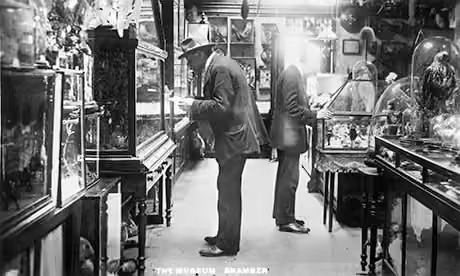
Walter Potter of Bramber

Taxidermy At The Great Exhibition 1851

Rare Walter Potter Tableau of Red Squirrels sells at auction £8,255

Walter Potter and Hermann Ploucquet compared

Hermann Ploucquet’s sensational tableaux at The Great Exhibition 1851
This article is part of the Taxidermy Today section. Explore more research here →
Subscribe to The Velvet Drawing Room
All content free to read | Just put your email address in below | Validate your opt-in to get an email when new articles are published |
All content free to read | Just put your email address in below | Validate your opt-in to get an email when new articles are published |
All content free to read | Just put your email address in below | Validate your opt-in to get an email when new articles are published |
All content free to read | Just put your email address in below | Validate your opt-in to get an email when new articles are published |
Discover more from thevelvetdrawingroom.co.uk
Subscribe to get the latest posts sent to your email.


